
You’re sitting at your prenatal appointment when your midwife or OB mentions something you weren’t expecting. “Your baby is posterior.” Or maybe you’re 35 weeks pregnant and you’ve just found out your baby is breech.
Suddenly, your mind starts racing. Does this mean labor is going to be harder? Will I need a C-section? Is there something wrong? Is there anything I can do?
First, I want you to know something incredibly important: Your baby’s position today does not necessarily determine how your birth will unfold.
One of my favorite reminders from BIRTHFIT is that position is a tendency, not a verdict. Babies move. Bodies change. Birth is an incredibly dynamic process that involves movement, rotation, and adaptation from both mom and baby.
As a prenatal chiropractor and a mom of two, I am passionate about helping women understand how their bodies function during pregnancy and what they can do to prepare for birth. At Rooted Family Chiropractic, we regularly work with moms whose babies are posterior, breech, or transverse, as well as moms who simply want to be proactive about their prenatal health. One thing I wish more expecting moms understood is that preparing for birth involves more than simply waiting for labor to begin. Your pelvis, nervous system, muscles, ligaments, and daily movement patterns all deserve attention throughout pregnancy.
Let’s talk about why.
Understanding Your Baby’s Position: What Do All Those Letters Mean?
Before we get into chiropractic care and movement, let’s break down what your provider actually means when they talk about your baby’s position.
Throughout pregnancy, your baby moves around inside your uterus. As you approach your due date, most babies settle into a head-down position in preparation for birth. But even when a baby is head-down, the direction they’re facing can make a difference in how labor progresses.
Left Occiput Anterior (LOA) is often considered one of the most favorable positions for vaginal birth. In this position, your baby is head-down, with the back of their head pointing toward the left-front portion of your pelvis. Their spine is generally facing toward the front of your belly. This position often allows your baby’s head to flex and navigate through the pelvis efficiently during labor. If your baby is already LOA, wonderful! Our focus is on supporting the comfort, mobility, and function of your body as you continue preparing for birth. Walking, intentional movement, breathwork, and exercises like the BIRTHFIT Basics can all be great ways to stay active and comfortable throughout pregnancy.
Right Occiput Anterior (ROA) is very similar to LOA, except your baby’s spine is positioned more toward the right side of your belly. This is also an anterior position and can be completely compatible with a smooth vaginal birth. Depending on how your baby rotates during labor, they may have a slightly different journey through the pelvis. For moms with babies in this position, we love incorporating movements that encourage comfortable hip mobility, pelvic floor relaxation, and rotation. Think gentle side lunges, hip flexor mobility, hands-and-knees movements, and intentional breathing. Remember, your body doesn’t need to be perfectly symmetrical or your baby positioned in one exact way for birth to happen beautifully.
Occiput Posterior (OP) positioning is one of the most common things we see in our prenatal chiropractic practice. When a baby is posterior, they’re head-down, but their spine is oriented more toward mom’s back rather than her belly. You may have heard this described as a “sunny-side-up” baby. There are two primary variations: left occiput posterior (LOP) and right occiput posterior (ROP). Posterior positioning can sometimes contribute to longer labor, more intense back discomfort, or additional rotation as baby moves through the birth canal. However, many posterior babies rotate during labor, and some are born posterior without significant complications.
What I find particularly interesting is what we often notice when examining the moms who come into our office with posterior babies. Many have restrictions through the pelvis and sacrum, tightness in the piriformis muscles, significant hip flexor tension, or sometimes restrictions around the pubic symphysis. Fetal position is influenced by several factors, but these are common findings and give us important information about how mom’s body is moving and functioning, and that’s where chiropractic care and intentional movement come into the conversation.
Breech positioning means your baby is positioned with their bottom or feet toward the birth canal instead of their head. Breech positioning is actually quite common earlier in pregnancy, and many babies naturally move into a head-down position as pregnancy progresses. However, when a baby remains breech later in the third trimester, the conversation becomes a little different. In the United States, most breech babies are delivered by cesarean, and fewer providers today have the training and experience necessary to attend vaginal breech births. While vaginal breech birth may still be an option with an experienced birth team, it isn’t widely available.
This is why I believe it’s valuable to be proactive when a baby is breech. There is no reason to immediately panic, but there is also no reason to ignore the opportunity to support your body, explore your options, and have meaningful conversations with your birth provider.
Transverse positioning means your baby is lying horizontally across the uterus rather than vertically. This position is relatively common earlier in pregnancy, when babies have more room to move. However, a baby who remains transverse near delivery requires additional planning with their obstetric provider because a persistent transverse lie is not compatible with a typical vaginal delivery. For these moms, we focus on supporting maternal comfort, pelvic mobility, and appropriate movement to decrease tension.
The important thing to remember is that your baby’s position is information. It isn’t a reason to immediately assume the worst.
What Does Your Pelvis Have to Do With Your Baby’s Position?
Here’s where I want to dive a little deeper, because this is something we discuss with pregnant moms almost every single day at Rooted.
Your pelvis is not simply a collection of bones that your baby has to squeeze through during birth. It’s a dynamic structure made up of the sacrum, two pelvic bones, joints, muscles, ligaments, and connective tissues that work together to support your growing body. Your uterus is supported within the pelvis by a network of ligaments and surrounding tissues. Your pelvic floor, hip muscles, abdominal muscles, and diaphragm all contribute to how your body manages movement, pressure, and stability.
During pregnancy, this entire system is adapting to some pretty incredible changes! As your baby grows, your center of gravity shifts. Your posture changes. Your muscles adapt to increasing demands, and your pelvis prepares for the movements required during birth.
But what happens when parts of that system aren’t moving particularly well? Maybe your sacrum isn’t moving comfortably. Maybe one hip is significantly tighter than the other. Maybe your piriformis muscles are constantly guarding, or your hip flexors are so tight that even standing comfortably becomes difficult. These are the kinds of biomechanical restrictions we commonly identify during prenatal chiropractic examinations.
When I work with a pregnant mom, I’m interested in understanding how her pelvis is moving, where her body is holding tension, and whether her nervous system and musculoskeletal system are adapting well to the demands of pregnancy. Our goal is to improve function and reduce unnecessary tension. The idea behind this approach is that a more comfortable, mobile, and balanced maternal pelvis may provide a more favorable environment for the natural movements of pregnancy and birth.
The Missing Piece: Your Nervous System
At Rooted Family Chiropractic, we don’t look at pregnancy exclusively through a biomechanical lens. We also pay close attention to the nervous system.
Your nervous system is constantly receiving information from your body and coordinating how you respond to that information. It plays a role in muscle tone, movement, breathing, stress responses, and so many other functions involved in pregnancy and birth. Think about what happens when you’re under stress. Your breathing may become shallower, your shoulders tighten, your jaw clenches, and your muscles become more guarded. Now imagine navigating all the physical changes of pregnancy while your body is consistently operating in that heightened state.
In our office, we frequently see pregnant moms who are carrying significant physical tension alongside high levels of emotional or physiological stress. Interestingly, we’ve also observed significant stress patterns in most of the moms whose babies are breech. This is one reason we take a neurologically focused approach to prenatal chiropractic care. Yes, I care if your back hurts… But really we want to understand how your body is adapting to stress and whether we can help improve the way you’re moving and functioning.
In my clinical experience, I’ve seen moms become noticeably more comfortable and relaxed with chiropractic care, and I’ve also cared for moms whose babies subsequently moved into different positions. Our goal is to support the mother, not move the baby, and that distinction is incredibly important.
What Is the Webster Technique, and How Does It Work?
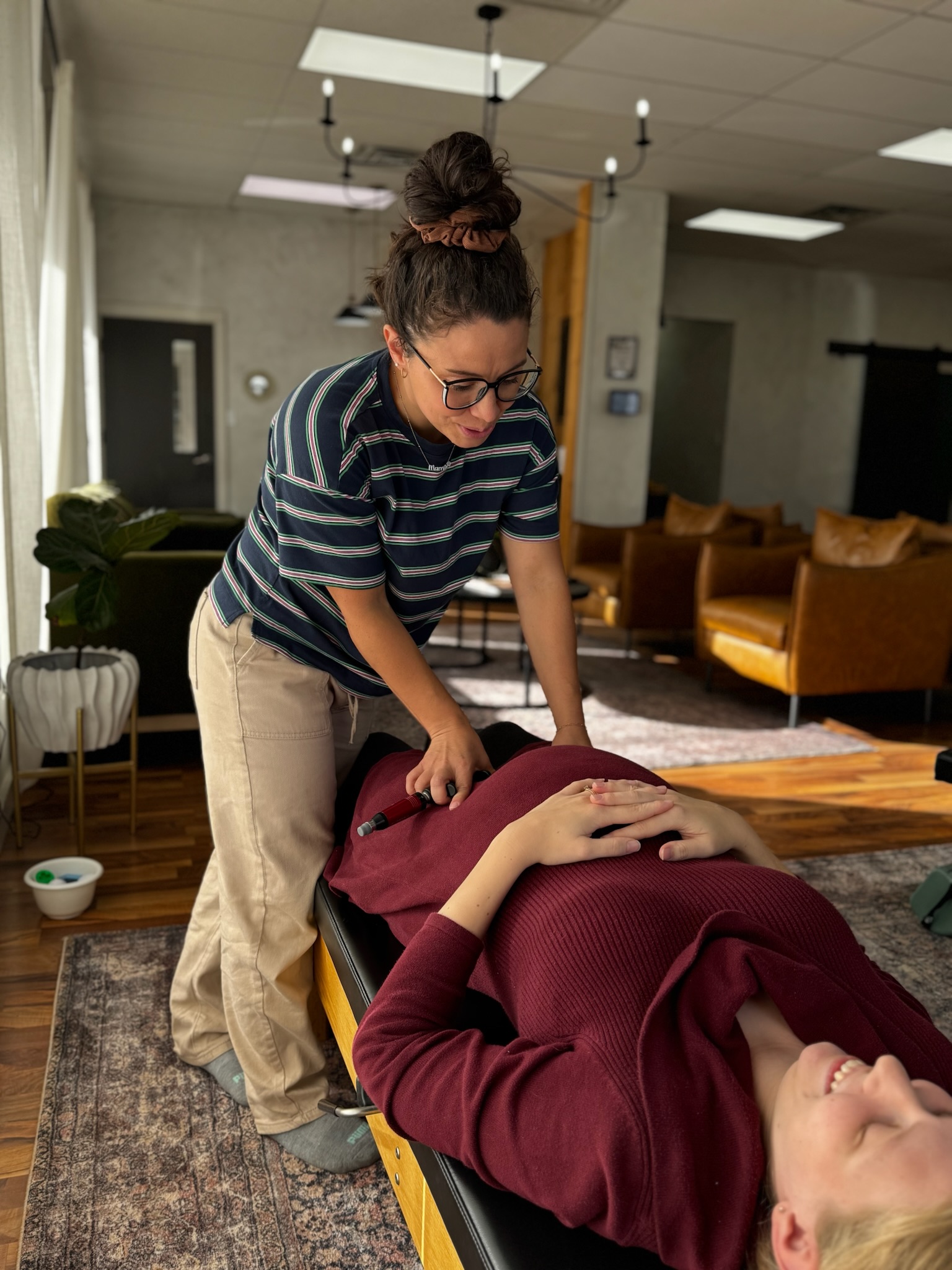
If you’ve researched prenatal chiropractic care, you’ve probably come across something called the Webster Technique. Both Dr. Sydney and I are certified in this technique, and it’s an important part of the prenatal care we provide at Rooted Family Chiropractic.
The Webster Technique is a specific chiropractic analysis and adjustment designed to address sacral and sacroiliac joint dysfunction and improve the neurobiomechanical function of the pelvis. That’s a mouthful, so let me explain what that actually means.
Your sacrum is the triangular bone at the base of your spine, positioned between your two pelvic bones. The sacroiliac joints connect your sacrum to your pelvis and play an important role in transferring forces through your body. During pregnancy, these structures are adapting to changes in weight distribution, posture, and ligament tension. With the Webster Technique, we evaluate how the sacrum and pelvis are functioning and use specific, gentle chiropractic adjustments to address areas of restriction.
We may also incorporate additional soft-tissue work depending on what we find during the examination. For example, we may work with tension involving the round ligaments, hip flexors, piriformis muscles, or other structures surrounding the pelvis. Our approach is individualized because no two pregnancies are exactly alike.
Now, here’s something I want to make very clear. The Webster Technique is not a technique for physically turning breech babies. We’re not manipulating your baby into a new position. We’re working with the mother’s body. The goal is to improve pelvic and sacral function, reduce unnecessary tension, and support the way her body adapts throughout pregnancy.
With these goals in mind, I encourage moms not to reserve prenatal chiropractic care for if they discover their babies are breech at 36 weeks. Supporting your body’s function throughout pregnancy is worthwhile long before you know your baby’s position.
We’ve Seen Many Babies Change Position. Here’s One Mom’s Story.
Over the years, we’ve had many moms come into Rooted with babies who were breech, posterior, or otherwise not in the position they were hoping for. And we’ve had the privilege of celebrating with many of those families when their babies subsequently moved into a head-down position.
One experience that stands out happened recently. A mom came into our office at 35 weeks pregnant after learning that her baby was breech. Understandably, she wanted to explore what she could do to support her body before making decisions about her delivery. We began providing prenatal chiropractic care, focusing on the restrictions and tension we identified throughout her pelvis and surrounding structures. After four adjustments, she learned that her baby had moved into a head-down position!
We were absolutely thrilled for her and stories like hers are part of why I’m so passionate about helping moms explore supportive options rather than feeling immediately defeated by a particular fetal position. This isn’t an isolated incident, as we have cared for many women whose babies changed position during the course of prenatal care.
My hope is that every mom who walks into our office feels informed, supported, and confident about the decisions she’s making for herself and her baby.
Chiropractic Is Only Part of the Equation: Movement Matters, Too!
If there’s one thing I wish more women incorporated into their pregnancies, it’s intentional movement. Not just exercising to stay in shape, but moving in ways that support the changing demands of pregnancy.
This is one of the reasons I love the philosophy behind BIRTHFIT and Spinning Babies. Both encourage women to become active participants in their pregnancies rather than feeling like they have no influence over their physical experience.
One of the movements I most commonly discuss with pregnant moms is the forward-leaning inversion, particularly when they’re experiencing significant pelvic pressure or their baby is posterior or breech. A forward-leaning inversion is a brief position in which the hips are elevated above the shoulders, creating a temporary change in the direction of gravity acting on the body. The Spinning Babies approach uses this movement with the intention of encouraging relaxation and adaptability in the tissues supporting the uterus.
I also personally used inversions during my pregnancies! When I was pregnant with Rory, I would sometimes use a slight inversion to take pressure off my pelvis. Interestingly enough, I actually started having contractions while I was in a slightly inverted position and she was born 3.5 hours later. That certainly made for a memorable experience!
***For moms interested in inversions, I recommend learning the technique properly rather than simply attempting to get upside down at home. These movements aren’t appropriate for everyone, particularly with certain pregnancy complications, and should be cleared by your prenatal provider.***
Another resource I love for expecting moms is the BIRTHFIT Basics. These foundational movements focus on breathing, posture, functional strength, and the connection between your diaphragm, abdominal muscles, and pelvic floor. One of the biggest misconceptions about preparing for birth is that we simply need to make our pelvic floors stronger. But your pelvic floor also needs to know how to relax!
During birth, your body relies on a coordinated relationship between breathing, muscular engagement, relaxation, and movement. I love encouraging moms to practice this coordination throughout pregnancy rather than waiting until they’re in labor to think about it. The BIRTHFIT approach also emphasizes movements that occur in multiple directions, including rotation. This matters because birth itself involves a series of movements and rotations as baby navigates through the pelvis.
Hip mobility and gentle rotational movements are another important part of preparing for birth. If you’ve ever watched a toddler squat, twist, crawl, and move effortlessly through a hundred different positions, you know that the human body was designed to move in more ways than simply forward and backward. Yet so many of us spend most of our days sitting, standing, or moving in relatively limited patterns.
During pregnancy, I love encouraging comfortable movements that explore hip mobility and gentle rotation. Depending on the individual, this might include supported side lunges, hands-and-knees movements, gentle hip flexor stretching, or pelvic mobility exercises. For moms with posterior babies, these movements can be especially useful for managing discomfort and exploring positions that feel better. The goal isn’t to aggressively stretch your body or force yourself into uncomfortable positions. It’s to maintain movement options and support your body’s ability to adapt.
And finally, don’t underestimate the value of walking and everyday movement. Sometimes we get so focused on specialized pregnancy exercises that we forget about the basics. Walking is one of the simplest ways to incorporate movement throughout pregnancy. It encourages natural movement through the hips and pelvis, supports circulation, and can help maintain endurance as you prepare for labor.
You don’t need an elaborate routine to benefit from movement. A comfortable walk, changing positions throughout the day, or taking breaks from prolonged sitting can all be meaningful ways to support your body. Consistency matters more than perfection.
What If Your Baby Is Already Posterior or Breech?
If you’re reading this because you’ve recently been told your baby is posterior or breech, I want to encourage you not to immediately assume your birth plans are out the window. Remember, babies move.
A baby who is posterior at 32 weeks may not be posterior during labor. And even if they are… many babies rotate from the posterior position as they navigate through the pelvis.
However, the closer you get to your due date, the more important it becomes to have an individualized plan with your birth provider. For posterior babies, that may mean exploring comfortable movement and labor positions, discussing strategies for managing back labor, and preparing for the possibility that labor may involve additional rotation.
No matter the position of your baby, I recommend starting with a prenatal chiropractor trained in nervous system care and The Webster Technique to help balance your body as best as possible.
The goal is not to make you fearful of a particular position. It’s to help you feel educated, prepared, and supported as you navigate your options.
Preparing Your Body for Birth Starts Long Before Labor
One of the biggest things I want pregnant moms to take away from this conversation is that you don’t have to wait until something feels wrong to start preparing your body for birth.
You don’t have to wait until you’re experiencing significant pelvic pain, struggling to sleep comfortably, or learning that your baby is breech at 36 weeks to begin paying attention to how your body is functioning.
Pregnancy is an incredible season of adaptation. Your body is growing an entirely new human while simultaneously preparing for one of the most physically demanding experiences of your life. I think that’s pretty amazing, and I believe it deserves intentional support.
As someone who has experienced two home births myself, I know how much preparation goes into feeling physically and mentally ready for labor. For me, chiropractic care, movement, and learning to work with my body were all important parts of that preparation. Not because I could control every aspect of my births, but because I wanted to do what I could to support my body throughout the process.
That’s the same perspective I want every expecting mom to have. Birth isn’t about achieving one perfect position, following one perfect exercise routine, or controlling every variable. It’s about supporting your body, giving yourself opportunities to move and adapt, and surrounding yourself with providers who support your goals while helping you make informed decisions.
Sometimes, the most empowering thing we can do is remind a mom that her body is capable of incredible things… so there’s your reminder!!!
Supporting Your Pregnancy at Rooted Family Chiropractic
Whether you’re 16 weeks pregnant and wanting to be proactive about birth preparation, or 35 weeks and have just learned that your baby is breech, we’d love to support you.
At Rooted Family Chiropractic in Holland, Michigan, we combine neurologically focused chiropractic care, Webster Technique, and individualized recommendations to help expecting moms feel more comfortable, confident, and prepared for birth.
Our approach goes beyond simply addressing back pain. We evaluate how your pelvis, sacrum, and nervous system are functioning, identify areas of restriction and tension, and work to support your body’s ability to adapt throughout pregnancy. We also love helping moms understand how intentional movement, breathing, and pelvic mobility can complement their prenatal chiropractic care.
Because ultimately, our goal isn’t to control your birth experience. It’s to help you feel supported, empowered, and as prepared as possible for it.
If you’re expecting and would like to learn more about how prenatal chiropractic care may fit into your birth preparation, we’d love to meet you!
Learn more about our prenatal chiropractic care, or schedule your New Patient Experience today. We’d love to be part of your pregnancy and birth preparation journey!”
By Dr. Kass Kasperski, DC | Rooted Family Chiropractic
