
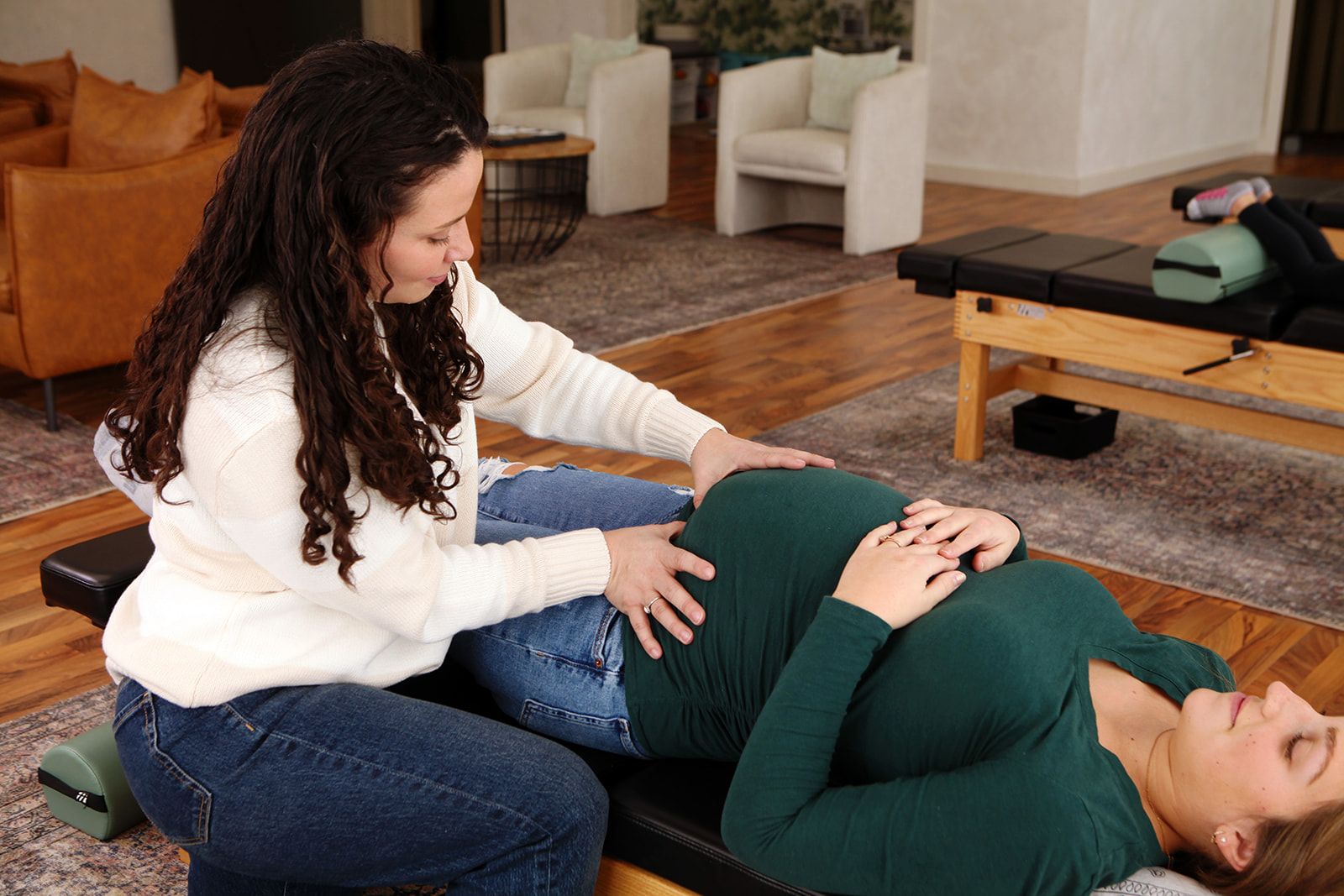
Pregnancy is incredible. Your body grows an entirely new human, builds an organ (hello, placenta!), changes its blood volume, shifts its center of gravity, adapts hormonally, and prepares itself to eventually bring your baby into the world.
That is a lot of change in a relatively short period of time.
So while pregnancy is completely natural, that doesn’t mean it isn’t a major physiological demand on your body.
And at the center of your body’s ability to adapt to all of it is one system we believe deserves much more attention during pregnancy:
Your nervous system.
At Rooted Family Chiropractic, many pregnant moms initially find us because something hurts. Maybe it’s low back pain, hip pain, pelvic discomfort, sciatica, headaches, or simply the feeling that their body isn’t moving the way it used to.
We absolutely care about helping you feel good throughout pregnancy.
But prenatal chiropractic care at Rooted goes much deeper than chasing aches and pains.
Our bigger goal is to help your body function and adapt as well as possible throughout pregnancy, prepare for birth, and support the neurological environment in which your baby is developing.
That’s why our approach to prenatal chiropractic care looks a little different.
And if you’re already scheduled for your first visit with us, this article will help you understand exactly why.
Pregnancy Isn’t Just a Structural Event
When most people think about chiropractic during pregnancy, they immediately think about the pelvis, and for good reason.
Your growing belly changes your center of gravity. Hormonal changes affect your ligaments. Your posture adapts. Your pelvis is preparing for birth. Muscles and joints throughout your body are being asked to function differently than they did before pregnancy.
We’ll talk more about pelvic balance and the Webster Technique in a moment.
But if we only look at pregnancy structurally, we’re missing a huge part of the picture.
Your nervous system is coordinating your body’s response to all of those changes.
The autonomic nervous system helps regulate many of the automatic processes happening in the background of your life, including heart rate, digestion, blood-vessel activity and stress responses.
During pregnancy, your body isn’t simply trying to maintain its usual workload. It is continually adapting to the demands of growing another human and this is why one of our biggest goals during pregnancy is adaptability.
Not perfection. Not eliminating every stressful event or expecting a pregnant mom to walk around in a state of Zen for nine months.
We want a nervous system that can appropriately respond to stress and then recover from it.
Think of it as having a good gas pedal and a good brake pedal.
Your Nervous System Has a Gas Pedal and a Brake Pedal
One of our favorite ways to explain the autonomic nervous system is by comparing it to a car.
Your sympathetic nervous system is like your gas pedal.
It helps your body mobilize. Your heart rate may increase, blood flow shifts, energy becomes readily available, and your body prepares to act. You absolutely need your gas pedal.
If a bear walked into the room right now, we would very much like your nervous system to respond! The problem isn’t having a gas pedal, but rather getting stuck with your foot on it.
Chronic physical, chemical and emotional stress can keep the nervous system spending more time in a protective, fight-or-flight state.
Your parasympathetic nervous system, on the other hand, functions more like your brake pedal. It is associated with recovery, digestion, conservation of energy and restorative processes.
Again, one isn’t “good” and the other “bad.” Health is the ability to appropriately use both.
A resilient nervous system can hit the gas when necessary and then return to the brake when the threat or demand has passed.
That adaptability becomes especially important during pregnancy and eventually during birth.
Your Baby Hitchhikes on Your Nervous System
This may be our favorite way to explain why nervous system health during pregnancy matters so much:
Your baby hitchhikes on your nervous system.
Your baby’s developing nervous system isn’t growing in isolation.
Baby is developing inside your physiological environment.
Researchers have spent decades studying the relationship between maternal physiology, prenatal stress and fetal development. We know, for example, that maternal stress hormones and placental signaling are part of the intrauterine environment experienced by a developing baby.
That does not mean experiencing stress during pregnancy is bad or that you should feel guilty every time you’re overwhelmed. READ THAT AGAIN.
You will experience stress while you’re pregnant. We all do.
Our goal isn’t to create a stress-free pregnancy.
Our goal is resilience.
Can your nervous system experience a challenge, respond appropriately, and then return toward regulation? This is very different from asking you to “just relax.”
The mother-baby connection doesn’t suddenly begin when your baby is born. After birth, babies rely heavily on co-regulation — your touch, voice, warmth, breathing, heartbeat, feeding and presence all help provide regulatory input as their immature nervous system continues developing.
But the cool thing is that the relationship has already been forming throughout pregnancy. So when we care for a pregnant mom at Rooted, we aren’t only thinking about how her back feels today. We’re thinking about the environment in which both mom and baby are navigating pregnancy together.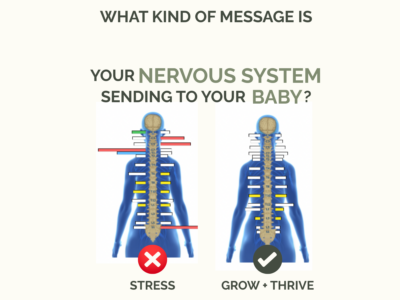
What Does This Mean for Baby?
One of our favorite things about caring for moms throughout pregnancy is getting to meet their babies on the other side. While every baby is different and we would never promise a specific outcome, we consistently notice something pretty special in many of the babies whose moms prioritized nervous system-focused care throughout pregnancy.
We often see babies who seem to adapt beautifully in those early weeks, with smoother digestion, less excessive fussiness and colic-like behavior, and healthy progression through early motor milestones.
And that connection makes sense when we zoom out.
Mom and baby are physiologically connected throughout pregnancy, and research continues to show associations between maternal prenatal stress and baby’s developing brain, autonomic nervous system, stress response, and later development.
This is another reason we care so deeply about supporting mom’s nervous system and ability to adapt throughout pregnancy. When we support mom, we’re thinking about the environment her growing baby is developing in, too.
So What Does Chiropractic Have to Do With the Nervous System?
Your brain and body are constantly communicating through your nervous system.
Your brain receives information about what’s happening throughout your body and your environment, processes that information, and coordinates an appropriate response.
When the neurospinal system is under increased stress and isn’t adapting efficiently, chiropractors refer to this altered function as subluxation.
At Rooted, our adjustments aren’t simply about “putting bones back into place.”
We use gentle, specific chiropractic adjustments intended to improve neurospinal function and support the body’s ability to adapt.
That’s an important distinction because it changes what we’re looking for.
If your only goal were to make your back stop hurting, we’d simply ask: “Where does it hurt?”
Instead, we want to know: “How is your nervous system functioning and adapting?”
That’s why your first visit at Rooted includes more than a conversation and a quick spinal check.
Your INSiGHT Nervous System Scans During Pregnancy
One of the biggest differences you’ll notice at Rooted is our use of INSiGHT nervous system scans as part of your first visit.
Rather than guessing about how your nervous system is functioning, these scans give us objective information that helps us better understand patterns of stress and adaptation.
Depending on your individual situation, our INSiGHT assessment may include technologies such as:
- Heart Rate Variability (HRV) to give us information related to autonomic nervous-system adaptability
- Surface electromyography (sEMG) to evaluate patterns of muscle activity along the spine
- Thermal scanning to evaluate temperature patterns along the spine that can provide additional information about autonomic function
One of the most common questions pregnant moms have is:
Are INSiGHT scans safe during pregnancy?
Yes.
These aren’t X-rays and they don’t expose you or baby to ionizing radiation.
The manufacturer states that INSiGHT scanning technologies are Class II FDA-registered devices that have undergone independent safety and electromagnetic-compatibility testing, and there are no contraindications for their use during pregnancy.
That allows us to gather objective information without radiation and, when appropriate, compare your scans over time.
Why We Pay So Much Attention to HRV During Pregnancy
One scan we especially value during pregnancy is Heart Rate Variability, or HRV.
Despite its name, HRV isn’t simply measuring how fast your heart beats. It looks at the tiny variations in timing between heartbeats, which provide information about autonomic nervous-system function and adaptability.
Generally speaking, we aren’t chasing one magical HRV number.
We’re interested in the bigger picture:
How well can your nervous system adapt?
Remember the gas and brake pedals? HRV gives us another window into that relationship.
Pregnancy itself places changing demands on the cardiovascular and autonomic nervous systems, so we interpret your findings in the context of you, your stage of pregnancy, your history, your other scans and your clinical exam. Then we can track changes over time rather than simply relying on how you feel on a particular day.
“But I Came Because My Back Hurts.”
We know and we care about that too! Pregnancy can bring low back discomfort, pelvic discomfort, hip tension, headaches, rib discomfort, pubic-area discomfort and all kinds of new sensations. Helping your body move and function better can absolutely be an important part of prenatal chiropractic care.
But here’s where our philosophy at Rooted differs:
Pain isn’t our only scoreboard.
If we only cared about pain, we’d stop asking questions as soon as your back felt better. Instead, we’re interested in how your entire system is adapting. And the really cool part is that this is where pregnant moms sometimes start telling us about what we jokingly call the “side effects” of chiropractic care.
They may originally come in saying:
“My back is killing me.”
And a few weeks later we hear:
“I’m sleeping better.”
“My digestion has been better.”
“I feel like I’m handling stress differently.”
“I have more energy.”
“I just feel better.”
Your body doesn’t have a separate nervous system for your back, another one for your digestion, another for sleep, and another for pregnancy. It’s all connected.
When our goal is improving neurospinal function and overall nervous system adaptability rather than simply covering up a symptom, often the changes people notice extend beyond the original reason they walked through our doors.
What About Pelvic Balance?
Now let’s talk about the other major piece of prenatal chiropractic care: biomechanics. As baby grows, your body continually changes to accommodate pregnancy. Your pelvis, sacrum, hips, lumbar spine, abdominal wall, pelvic floor, ligaments and surrounding muscles all have to work together.
We want those structures functioning with as much balance and mobility as possible.
Why?
Because birth is physical.
Your pelvis isn’t a rigid structure. It is designed to move. Supporting normal pelvic and sacral biomechanics throughout pregnancy is therefore an important part of preparing your body for the physical demands ahead.
This is also where the Webster Technique comes in.
What Is the Webster Technique?
The Webster Technique is a specific chiropractic analysis and adjustment commonly used during pregnancy. The International Chiropractic Pediatric Association (ICPA) defines its goal as reducing the effects of sacral subluxation and/or sacroiliac joint dysfunction to improve neuro-biomechanical function in the sacral and pelvic region.
In simpler language:
We’re looking at how your sacrum and pelvis are functioning and working to improve that function.
There is also an important misconception we want to clear up.
Webster is not a “breech baby turning technique.”
Chiropractors don’t turn babies. What we can do is evaluate mom. We can address her sacral and pelvic function, surrounding tension and neuro-biomechanics so her body has the opportunity to function as well as possible. Baby gets to decide what baby does from there.
This is one reason we love using Webster principles throughout pregnancy rather than waiting until 37 weeks when someone discovers baby isn’t in her preferred position.
Our goal is not crisis management. Our goal is supporting function throughout the journey.
Your Nervous System During Birth: You’ll Need BOTH Pedals
This is where the nervous-system conversation gets especially fascinating. Birth isn’t simply about being “relaxed.” It requires incredible neurological adaptability.
Early labor is supported by conditions that allow safety, privacy, oxytocin release and parasympathetic influence. Think about other mammals: they generally seek a quiet, protected place to give birth.
Then labor intensifies. Eventually, mom needs tremendous activation and physical output. That’s your gas pedal doing an important job.
After the baby arrives, we want the ability to transition again. Baby comes to mom’s chest. Skin touches skin. Baby hears the familiar heartbeat and voice. Breathing, temperature, feeding and connection begin transitioning into life outside the womb. This is co-regulation in action.
Our own Birth & Beyond workshop describes birth through this same gas-and-brake framework: accessing the “brake,” mobilizing the “gas” when necessary, and transitioning back toward the brake and co-regulation after birth.
That is why we don’t define a “regulated nervous system” as a nervous system that’s always calm.
A regulated nervous system is adaptable.
It can mobilize when necessary and it can recover when the demand has passed.
Birth may be one of the greatest tests of adaptability your nervous system will ever experience, so let’s make sure your nervous system can flow between the gas and brake.
Does Prenatal Chiropractic Guarantee an Easier Birth?
No and anyone promising you a perfect birth is promising something they can’t control, because birth has so many variables.
Sometimes intervention is necessary. Sometimes plans change. Sometimes incredibly prepared women have C-sections. Sometimes babies need additional medical support. Our goal isn’t to create fear around intervention or convince you there’s only one “right” way to give birth.
Instead, we want to ask:
How can we help prepare your body and nervous system as well as possible for whatever your birth requires of you?
We want a body that moves well, a pelvis functioning well, a nervous system capable of adapting, and a mom who understands her options.
Lastly, a birth team that supports her goals while also being able to respond appropriately if circumstances change.
We can’t control birth but we absolutely can prepare for it.
The “Perfect Storm” Starts Earlier Than Most Parents Realize
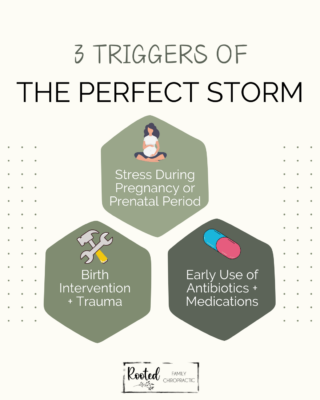
If you’ve been around Rooted for a while, you’ve probably heard us talk about something called The Perfect Storm.
The Perfect Storm isn’t a diagnosis. It’s the framework we use to look at how layers of physical, chemical, and emotional stress can accumulate over time, sometimes beginning during pregnancy and birth, rather than pointing to one isolated event as the cause of a child’s future challenges.
Prenatal stress may be one piece. A difficult or highly interventional birth may be another. Early feeding challenges, illness, medications, environmental stressors, falls, injuries, and other experiences may add additional layers as a child grows.
But this is where we want to be extremely clear:
This is not about blaming moms.
A stressful pregnancy doesn’t mean you’ve harmed your baby. An induction, epidural, or c-section isn’t a failure. Sometimes those interventions are wanted or necessary. Sometimes birth simply doesn’t go according to plan.
The point of understanding the Perfect Storm isn’t to create fear.
It’s to recognize that nervous-system adaptability matters, and supporting it can begin before baby ever takes a first breath.
That gives us an incredible opportunity!
Instead of waiting for problems, we can start thinking proactively about neurological health during pregnancy.
Your Birth Team Matters, Too
Chiropractic care is one important piece of a healthy pregnancy and birth.
One of the things we emphasize in our Birth & Beyond workshop is surrounding yourself with providers who understand your goals, respect your choices, and help you feel informed and empowered throughout pregnancy, birth, and postpartum.
Depending on your needs and preferences, your team may include:
- an OB or midwife
- a doula
- a pelvic floor physical therapist
- a prenatal chiropractor
- a lactation professional
- other appropriate medical or wellness providers
You need everyone on your team to support the vision you have for birth, be open to answering your questions, and help you understand your options.
We want you to feel informed and empowered as you make decisions for yourself and your baby because pregnancy shouldn’t simply be something that happens to you.
Want to go even deeper? We regularly host Birth & Beyond, our pregnancy and birth workshop designed to help expecting moms learn more about preparing their body and nervous system for pregnancy, birth, and postpartum. You can find upcoming dates on our events and workshops page.
What Your First Prenatal Chiropractic Visit at Rooted Looks Like
If you’re reading this because you’ve already scheduled your first appointment, here’s what we want you to know: We’re going to listen first.
We want to hear about more than your low back, even if that is what’s bringing you in. We’ll talk about your pregnancy, previous pregnancies and births when applicable, current symptoms and challenges, stress, sleep, digestion, goals for care and what you hope your birth experience looks like.
Then we’ll evaluate how your body and nervous system are functioning.
That includes your INSiGHT neurological scans, along with the appropriate chiropractic examination and assessment of your spine, sacrum and pelvis.
We aren’t looking for a generic pregnancy care plan.
We’re looking at you, your scans, your nervous system, your history and your goals.
From there, we’ll review what we’ve found and explain our recommendations so you understand the why behind your care.
When Should You Start Prenatal Chiropractic Care?
We get this question all the time and there isn’t one particular week when prenatal chiropractic suddenly becomes relevant.
Some women begin care before conception, which is our favorite time because it’s where we can make the most impact.
Others start in their first trimester because nervous-system health is already a priority for them. YAY!
Some find us halfway through pregnancy and plenty of women walk through our doors in the third trimester saying:
“Okay… I probably should have done this sooner.”
Our philosophy is simple:
Earlier gives us more time to support your body as it changes, but it’s never too late to support your body and nervous system in this journey.
We meet you where you are.
Pregnancy Is About More Than Surviving Until Your Due Date
There is a tendency to treat pregnancy like something a woman simply needs to endure.
Get through the nausea.
Get through the aches.
Get through the sleepless nights.
Get to 40 weeks.
Have the baby.
We think moms deserve a bigger vision than that.
What if pregnancy became an opportunity to learn how your body works?
What if birth preparation included more than buying the right stroller, packing the hospital bag and drinking raspberry leaf tea?
What if we prepared the nervous system that actually has to navigate the experience?
Yes, we want you comfortable.
Yes, we care about your back and pelvis.
But ultimately, our goal for prenatal chiropractic care at Rooted is much bigger:
We want to help your nervous system function and adapt as well as possible so you can experience pregnancy from a place of greater resilience, prepare your body for birth, and create a supportive neurological environment for the little person hitchhiking on your nervous system for nine months.
Because when we care for mom during pregnancy, we’re never really caring for just one person… We’re thinking about both of you.
Looking for a Prenatal Chiropractor in Holland, Michigan?
At Rooted Family Chiropractic in Holland, MI, our doctors provide neurologically focused prenatal chiropractic care, including INSiGHT nervous system scans, gentle and specific chiropractic adjustments, and the Webster Technique.
Whether you’re looking for help with the physical changes of pregnancy or want a proactive approach focused on nervous-system function, pelvic balance and preparing your body for birth, we’d love to meet you.
Learn more about prenatal chiropractic care at Rooted Family Chiropractic or contact our team to schedule your first visit.
This article is for educational purposes and is not intended to replace prenatal medical care, diagnosis, or treatment. Chiropractic care is designed to support neuro-musculoskeletal function and does not guarantee specific pregnancy, fetal, labor, or birth outcomes.
