If your child has been diagnosed with ADHD — or you suspect they might have it — you’ve probably already heard plenty about managing the symptoms: behavior charts, medication, therapy, classroom accommodations. What you likely haven’t heard much about is why your child’s nervous system is wired this way in the first place.
At Rooted Family Chiropractic in Holland, MI, we believe that question matters. Not because managing symptoms isn’t important — it is — but because understanding the root cause changes what’s possible for your child’s long-term health.
This article walks through what we call the “Perfect Storm” — the combination of factors that, layered on top of one another, can prime a child’s nervous system for the hyperactivity, impulsivity, and inattention we label as ADHD. We’ll also explain how nervous system-focused pediatric chiropractic care, supported by INSiGHT scanning technology, fits into a natural, drug-free approach to ADHD support for families here in Holland and beyond.

ADHD Isn’t a Behavior Problem. It’s a Nervous System Pattern.
It’s easy to think of ADHD as a discipline issue or a focus issue. But underneath the behaviors, ADHD reflects something happening at the level of the autonomic nervous system —the part of the brain and body responsible for regulating stress responses, attention, and self-control.
Think of your child’s nervous system like a car with a gas pedal and a brake pedal. The gas pedal is the sympathetic nervous system (fight-or-flight). The brake pedal is the parasympathetic nervous system (rest-and-digest, calm-and-connect). In a well-regulated child, both pedals work together, engaging when needed, and releasing when it’s time to settle down and focus.
In many children with ADHD, that balance is off. The gas pedal is stuck partially down, and the brake pedal isn’t strong enough to counter it. The result looks like hyperactivity, impulsivity, difficulty sitting still, and trouble sustaining attention — not because a child is choosing to misbehave, but because their nervous system is stuck in a state of chronic overstimulation.
The question worth asking is: what caused that imbalance to begin with?
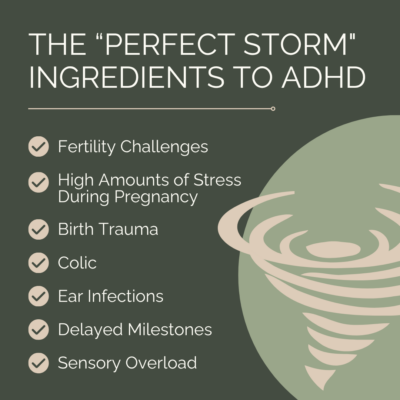
The Perfect Storm: Three Layers That Build on Each Other
Rather than pointing to a single cause, we look at ADHD as the result of a cumulative pattern — a series of stressors that build on one another over time. We have seen this pattern in hundreds of case histories and call this pattern the Perfect Storm. It typically unfolds in three phases.
1. Pregnancy Stress
A baby’s nervous system doesn’t start developing at birth. It starts developing in the womb, and it develops in direct relationship with the mother’s nervous system. The umbilical cord isn’t just a nutrient delivery line; it also carries the biochemical signature of the mother’s stress state.
When a pregnant mother experiences prolonged or high levels of stress, her body produces elevated stress hormones. Those hormones cross the placental barrier and reach the developing baby, potentially shaping how that baby’s own stress-response system develops before they’re even born. A nervous system that develops under chronically elevated stress hormones may be primed toward a heightened, reactive baseline from day one.
This isn’t about blaming mothers for feeling stressed during pregnancy, though! We understand that stress during pregnancy is extremely common and often unavoidable. It’s about understanding that this is layer one of the storm, not the whole picture.
2. Birth Interventions
Birth is a physically demanding process for both mother and baby, and modern birth often involves interventions that, while sometimes medically necessary, can add physical stress to a baby’s developing nervous system.
Forceps deliveries, vacuum extraction, induced labor, and emergency C-sections can all place strain on a newborn’s head, neck, and upper spine — areas that house the brainstem and vagus nerve, which help regulate heart rate, digestion, sensory processing, and the body’s overall stress response. When those areas experience trauma or tension during birth, it can interfere with how efficiently the nervous system communicates with the rest of the body.
This is layer two of the storm, stacking directly on top of layer one.
3. Early-Life Stressors
The first months and years of life bring their own set of potential stressors: antibiotic use, hospital stays, illness, surgery, falls, and the general physical demands of learning to hold up a heavy head, roll, crawl, and walk.
Each of these events, on their own, might be minor. But for a nervous system that’s already primed from pregnancy stress and strained from a difficult birth, these early-life stressors can be the final layer that tips things into visible dysregulation: colic, reflux, sleep trouble, sensory sensitivities, and eventually, behaviors that get labeled ADHD.
Why “Perfect Storm” Matters as a Concept
No single one of these factors “causes” ADHD on its own. Plenty of children experience one or two of these stressors and develop just fine. What we’re describing is a cumulative effect. Layer after layer of stress landing on a developing nervous system during the exact windows when it’s building its lifelong regulatory patterns.
This is also why the same underlying nervous system dysregulation can show up differently as a child ages. Colic at two months can look more like sensory sensitivities at eighteen months, ADHD symptoms at five years and anxiety at age ten, often show the same patterns of dysregulation in the nervous system. The neurology doesn’t necessarily change; it just gets a different name depending on when a parent (or pediatrician) notices it.
Where Traditional ADHD Approaches Fall Short
Conventional ADHD care tends to focus almost entirely on managing symptoms, most commonly through stimulant medication and behavioral therapy. Both can genuinely help families cope day to day. But neither one addresses the underlying nervous system imbalance driving the symptoms in the first place.
That’s the gap we focus on filling: identifying and addressing the nervous system dysregulation itself, not just the behaviors it produces.
How Nervous System-Focused Chiropractic Care Fits In
At Rooted Family Chiropractic, Dr. Rob and Dr. Kassidy Kasperski start every case by actually measuring what’s happening in your child’s nervous system… not just guessing.
INSiGHT Scanning: Seeing What’s Beneath the Surface
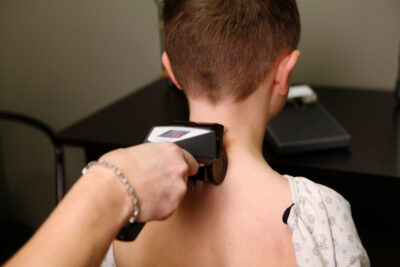
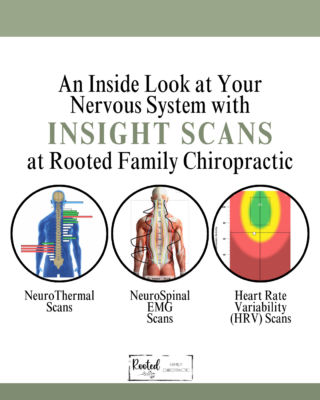
We use INSiGHT Scan technology, a set of non-invasive, painless scans that measure and help identify how well your child’s nervous system is regulating stress. These scans give us objective, measurable data on autonomic nervous system function — essentially a window into whether your child’s “gas and brake pedals” are functioning as they should.
This matters because it moves the conversation beyond symptoms and behavior checklists, and into actual nervous system function. It also gives us a baseline we can track over time, so you can see whether your child’s nervous system regulation is improving.
What Do ADHD Scans Typically Show?
While every child’s scan is unique, we tend to see a few recurring patterns in kids who come to us with ADHD symptoms:
- sEMG (surface electromyography): This scan measures muscle activity along the spine, which reflects how much nervous system “noise” or energy output a child is carrying. In ADHD kiddos, we commonly see high and often disorganized energy patterns — a physical echo of the hyperactivity and restlessness parents describe at home and school.
- Thermal Scan: This scan measures how well the autonomic nervous system regulates temperature along the spine, which reflects how evenly the nervous system is coordinating on both sides of the body. ADHD kiddos often show several areas of dysregulation, most commonly concentrated in the upper neck and head region — the same area most affected by the birth interventions and early stressors discussed above.
- Heart Rate Variability (HRV): This scan measures the balance between the sympathetic (gas pedal) and parasympathetic (brake pedal) nervous system. In many ADHD kiddos, HRV shows a sympathetic-dominant pattern — a nervous system stuck in overdrive. In older kids and teens, however, we sometimes see the opposite: a system that looks less “revved up” and more worn down, reflecting the toll of years spent in a dysregulated state.
A note on medication: If your child is currently taking ADHD medication, it’s important to know that stimulant medications can affect HRV readings. This doesn’t mean scanning isn’t valuable for medicated kids — it simply means we factor medication into how we interpret the results, so you get an accurate picture of what’s happening rather than a skewed one.
Neurologically-Focused Chiropractic Adjustments
Based on what the scans show, we provide gentle, specific chiropractic adjustments focused on the areas of the spine most connected to nervous system function — particularly the upper neck and brainstem region, which are often affected by the birth interventions and early physical stressors described above.
The goal isn’t to “crack backs” or treat a symptom in isolation. It’s to reduce nervous system interference so that your child’s body has a better opportunity to self-regulate, calm the sympathetic (fight-or-flight) overdrive, and strengthen parasympathetic (calm-and-connect) function.
A Full Picture, Not a Quick Fix
During a pediatric chiropractic consultation, we take time to understand your child’s full history. This includes pregnancy, birth story, early illnesses, antibiotic use, hospital stays, and developmental milestones. This history, combined with INSiGHT scan data, allows us to build a care plan specific to your child’s version of the Perfect Storm, rather than a one-size-fits-all protocol.
What This Means for Your Family
If your child has been diagnosed with ADHD, or you’re noticing signs of hyperactivity, impulsivity, or attention struggles and wondering what’s really going on, here’s what we want you to know:
- This isn’t your fault. Pregnancy stress, birth interventions, and early-life medical needs are common and often unavoidable.
- It’s not too late. The nervous system remains adaptable well beyond early childhood. Awareness is the first step toward change.
- Symptoms and root causes are different things. Managing behavior is helpful, but addressing the underlying nervous system pattern is where lasting change tends to happen.
- You don’t have to guess. Scanning technology lets us look at actual nervous system function instead of relying on symptom checklists alone.
What Other Rooted Families Are Saying
Show Image
“Our son faced early challenges that led to nervous system dysregulation, which manifested as excess energy, trouble focusing, big emotions, anxiety, and constant chewing on his shirt or nails. Despite trying everything… it was clear something deeper was at play. When we saw the scans and understood the source of the issue, we finally felt seen and understood. The changes were gradual but noticeable: fewer intense emotions, better school behavior, improved sleep, and more confidence.” — Luke’s mom · Read Luke’s full story →
“She was constantly exhausted, battling severe migraines, struggling to focus in school, and watching her grades plummet… Aleena’s grades skyrocketed from F’s to A’s and B’s. Today, Aleena is thriving. The migraines are gone. Her focus in the classroom has sharpened.” — Aleena’s family · Read Aleena’s full story →
Read more real family outcomes on our Stories of Hope page.
A Note on What This Article Is (and Isn’t)
This article is educational in nature and reflects the nervous system-focused philosophy we practice at Rooted Family Chiropractic and the common themes we see in practice every day. It is not intended to diagnose, treat, or cure ADHD or any medical condition, and it isn’t a substitute for evaluation and care from your child’s pediatrician or other qualified healthcare providers. ADHD is a complex, multi-factorial condition, and we believe the best outcomes come from families having a full care team, which chiropractic care can be one meaningful part of.
Curious What Your Child’s Nervous System Scan Would Show?
If you’re local to Holland, MI and want to understand what might be contributing to your child’s ADHD symptoms — not just manage them — Dr. Rob and Dr. Kassidy Kasperski and the team at Rooted Family Chiropractic would love to talk with you.
Schedule a consultation and INSiGHT scan and let’s take a real, measurable look at your child’s nervous system together.
Request an Appointment → Call us at 616-886-5883 →
Not Ready to Book Yet? Join Us for a Free Perfect Storm Workshop
If you’d rather start by learning more before scheduling, we host a free monthly Perfect Storm Workshop for parents — covering how pregnancy stress, birth interventions, and early-life stressors can contribute to ADHD, autism, anxiety, and sensory challenges in kids.
