When parents think about their child’s health, they usually focus on the symptoms they can see.
A toddler who never sleeps through the night.
A preschooler who breathes through their mouth.
A child with crowded teeth, chronic congestion, big emotions, or difficulty focusing.
At first glance, these concerns seem unrelated. One family may see a dentist. Another visits an ENT. Another seeks occupational therapy or behavioral support.
But what if some of these challenges share a common foundation?
At Rooted Family Chiropractic, we’ve become increasingly interested in one question:
How does the way a child’s face and skull develop influence the way they breathe, sleep, regulate, and grow?
This question has led both of our doctors to pursue advanced education in pediatric cranial work, allowing us to better evaluate the relationship between cranial development, airway function, and the nervous system.
he Modern Face Is Changing
One of the most fascinating discoveries in craniofacial research is that today’s children often look different than previous generations.
Many experts have observed increases in:
- Narrower upper jaws (maxillae)
- Higher, narrower palates
- More crowded teeth
- Recessed chins
- Smaller nasal airways
- Chronic mouth breathing
Rather than viewing these as isolated cosmetic concerns, many clinicians now recognize them as signs of changing craniofacial development.
The encouraging news? Much of this appears to be influenced by environment and function… not simply genetics.
Factors such as chronic congestion, mouth breathing, tongue posture, infant feeding, soft modern diets, birth stress, and early developmental patterns all contribute to how a child’s face grows over time.
In other words… Structure develops in response to function.
Your Child’s Face Is Still Growing
The first few years of life represent one of the fastest periods of growth the human body will ever experience.
A baby’s brain doubles in size during the first six months of life. By age two, it has reached approximately 80% of its adult size, and by age five, much of the rapid growth of both the brain and skull has already occurred.
During this same window, the bones of the face are constantly adapting.
The upper jaw, called the maxilla, forms both the roof of the mouth and the floor of the nasal cavity. As it grows, it helps determine how much room exists for healthy nasal breathing.
This is one reason why we, as pediatric providers in Holland, MI, are paying closer attention to craniofacial development during infancy and early childhood
Why Oxygenation Matters
Every breath your child takes delivers far more than oxygen. Healthy breathing helps support restorative sleep, healthy nervous system regulation, brain development, and normal growth.
When nasal breathing becomes difficult, children don’t stop breathing, rather they adapt.
Many begin breathing through their mouths instead.
While this adaptation keeps them alive, it may not always provide the same efficiency as quiet nasal breathing. Researchers continue to study how chronic mouth breathing and sleep-disordered breathing may influence sleep quality, attention, learning, emotional regulation, and overall development.
That doesn’t mean every child who mouth breathes will experience these challenges, nor does it mean airway concerns explain every diagnosis. It does mean that breathing quality is an important piece of the developmental puzzle.
At Rooted, we believe healthy breathing, (which stems from a healthy nervous system) creates a strong foundation for healthy development.
The Nervous System Is Always Adapting
One of our favorite sayings in the office is:
The body is always adapting.
If breathing becomes more difficult… the body adapts.
If sleep becomes less restorative…the nervous system adapts.
If structural tension develops early in life… the brain adapts.
These adaptations aren’t “bad.” They’re the body’s way of surviving. But sometimes those survival patterns become the new normal.
That’s why our office spends so much time evaluating the nervous system, not just symptoms. Through our advanced INSiGHT Scans, we measure how your child’s nervous system is adapting to stress so we can better understand the bigger picture before making recommendations. INSiGHT Scans and What to Expect.
Where Pediatric Cranial Work Fits
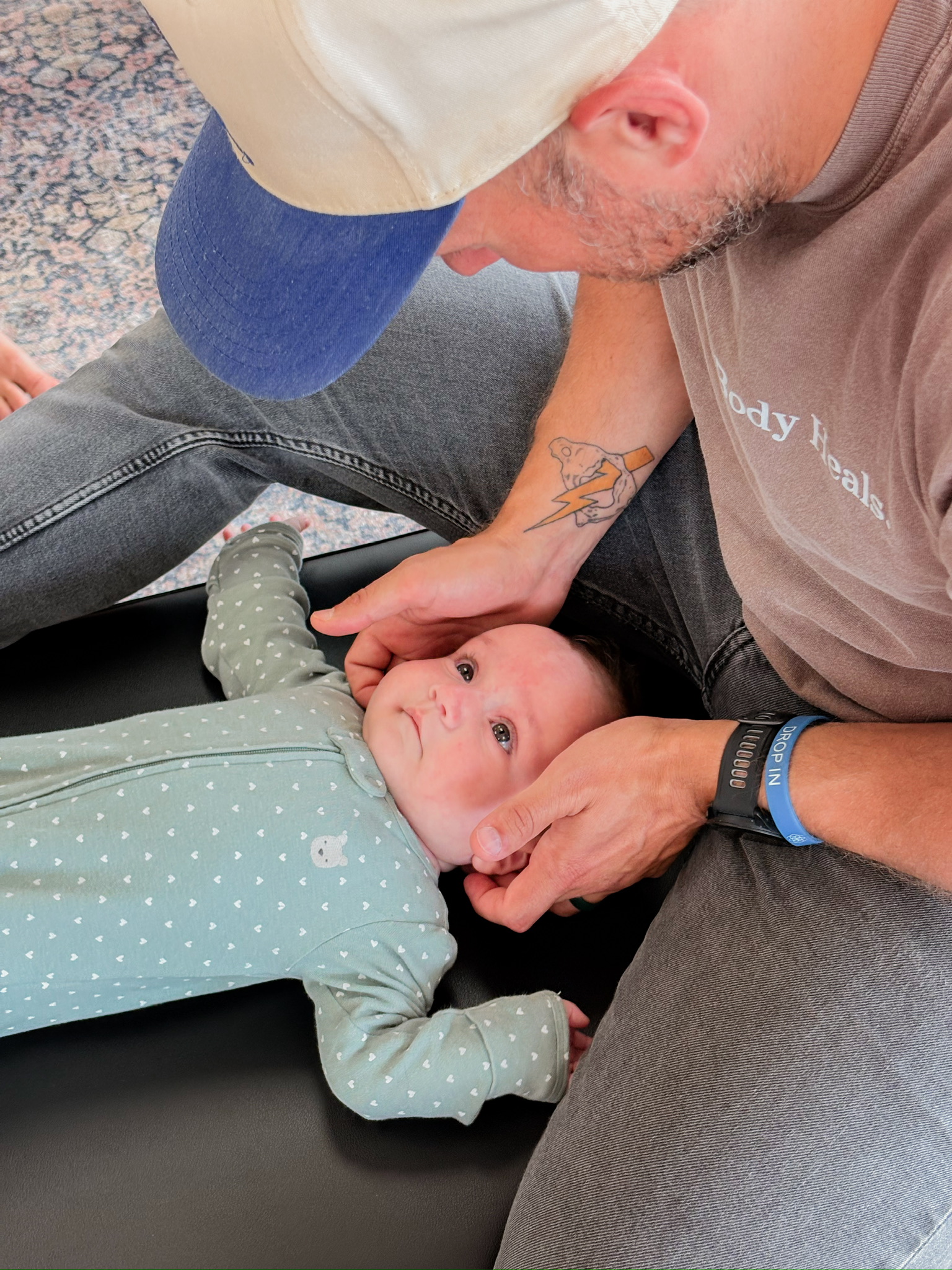
Pediatric cranial work is one of the many tools we may incorporate into care when clinically appropriate. Rather than focusing on force, pediatric cranial work uses gentle, specific contacts intended to evaluate and support normal motion within the cranial system.
Our goal is not simply to “adjust the head.” Our goal is to better understand how a child’s structure may be influencing their function.
Both Dr. Rob and Dr. Kass have invested in advanced education to better serve families in this area.
- Dr. Rob has completed advanced Pediatric Sacro Occipital Technique (SOT) cranial training, through the Peak Potential Institute
- Dr. Kass has completed Craniosacral Therapy (CST) certification coursework and is currently pursuing additional advanced cranial education.
- Together, we integrate multiple approaches into the individualized care we provide.
Every child is different, which means that not every child receives cranial work. We first focus on balancing the neurospinal system, then when indicated, pediatric cranial work may be incorporated alongside neurologically focused chiropractic care. These clinical decisions for care are based on your child’s examination findings and individual needs.
What About Cerebrospinal Fluid?
Another reason cranial development has gained attention is its relationship with cerebrospinal fluid (CSF). CSF cushions the brain and spinal cord, transports nutrients, helps remove metabolic waste through the brain’s glymphatic system, and contributes to the brain’s normal physiologic environment.
Researchers continue to explore how healthy movement and pressure dynamics throughout the cranial system support these normal processes. While more research is still emerging regarding specific clinical applications, this growing understanding is one reason many providers have become increasingly interested in normal cranial motion, especially during periods of rapid childhood development.
Looking Beyond Symptoms
At Rooted, you’ll notice that we don’t simply ask:
“What symptom brought you in?”
We also ask:
- How is your child sleeping?
- Do they primarily breathe through their nose or mouth?
- Is there significant cranial asymmetry?
- How did pregnancy and birth influence early development?
- Are developmental milestones happening with ease?
- How is the nervous system adapting?
Those questions often reveal a much bigger story, because every child’s body is adapting to the experiences it’s had since the very beginning.
Why We’ve Invested in Advanced Cranial Training
As pediatric chiropractors, we believe the earliest years of life offer one of the greatest opportunities to support healthy development. The brain is growing rapidly; the face is developing; reathing patterns are becoming established; and the nervous system is learning how to regulate the body for a lifetime.
That is why we’ve continued investing in advanced education through organizations like the Peak Potential Institute, Pediatric SOT, and Craniosacral Therapy.
Not because cranial work is a “magic technique.”
But because we believe understanding how structure influences function allows us to care for children more thoughtfully and more completely.
Caring for the Whole Child
At Rooted Family Chiropractic, we don’t chase symptoms. We look at the nervous system as the foundations that allow children to thrive. With this in mind we’re also paying attention to:
- Healthy nervous system function
- Healthy breathing patterns
- Craniofacial development
- Movement
- Sleep
- Growth
- Adaptation
Because when the foundation is strong, children are better equipped to grow and develop ideally.
If you’d like to learn more about our approach to caring for children, explore our Pediatric Chiropractic page, discover our Perfect Storm framework, or read about what to expect during your first visit and how our INSiGHT Scans work. Together, these resources provide a deeper look at how we evaluate the nervous system and create individualized care plans for growing families in Holland, MI and surrounding West Michigan areas.
Pediatric Chiropractic Care in Zeeland, MI
Pediatric Chiropractic Care Hudsonville, MI
Pediatric Chiropractic Care West Olive, MI
Pediatric Chiropractic Care Saugatuck, MI
