

If you’ve spent the last several nights googling “why is my baby so fussy” at 2 a.m. with a screaming newborn on your chest, you are not alone. You are not imagining it. Maybe you’ve already been to the pediatrician, tried the formula switch, cut out dairy, and stocked up on gripe water, and you’re still no closer to an answer. A lot of parents in Holland, Zeeland, and Hudsonville end up right here, after doing everything “right” and still not getting relief.
Here’s what most pediatric visits don’t have time to explain: colic, reflux, silent reflux, constipation, gas, and grunting are rarely separate, random problems. In many babies, they’re different symptoms of the same underlying issue: a nervous system that is under stress and struggling to regulate digestion.
This guide walks through what’s actually happening in your baby’s body, how to tell normal newborn fussiness from something that needs support, and what a root-cause, nervous-system-focused approach looks like.
Quick Answer: Why Is My Baby So Fussy?
Most persistent infant fussiness (crying, arching, grunting, straining, spitting up, and difficulty sleeping unless held) traces back to an immature or stressed nervous system that hasn’t yet learned to smoothly coordinate digestion. Birth is physically demanding on a newborn’s spine and nervous system, and when that stress isn’t resolved, it can show up as colic, reflux, or constipation, often all at once. Babies aren’t broken and parents aren’t doing anything wrong. The nervous system simply needs support to do its job.
Why Babies Aren’t Meant to Struggle Like This
A newborn’s body is designed to eat, sleep, digest, and grow with relative ease. When a baby is chronically fussy, crying for hours, arching in pain, or straining through every diaper, that’s not “just what babies do.” It’s a sign that something is interfering with normal function.
Here at Rooted Family Chiropractic in Holland, MI, our philosophy is simple: the body has the ability to heal, as long as there is no interference. All we’re doing with a chiropractic adjustment is removing the interference between brain and body, so a baby’s body can do what it was designed to do: eat, sleep, poop, grow, and develop.
The nervous system is the master control system of the body. It controls everything by sending signals from the brain, down the spinal cord, and out through the nerves to every cell, tissue, and organ. It tells the lungs to breathe, the heart to beat, and (critically for fussy babies) it tells the digestive tract when to relax, when to contract, and when to move things along. When that control system is under stress or interference, digestion is one of the first things to suffer, because the body prioritizes survival functions over “rest and digest” functions.
This is the piece so many parents never hear: your baby’s crying doesn’t mean they’re a bad baby or that you’re doing anything wrong. It’s frequently a communication problem between the nervous system and the digestive system. And for a newborn, that foundation (eat, sleep, poop) has to be solid before anything else can be built on top of it. Optimal growth and development depends on that foundation being strong. For babies, that foundation is the autonomic nervous system, and it shows up as eat, sleep, poop. Everything else builds on that.
Three Things Every Healthy Nervous System Should Do Well
When parents come into our office, they’re often focused on one symptom. Reflux. Colic. Constipation. Poor sleep. Excessive crying. But before we talk about diagnoses, we ask a much simpler question: Is your baby eating well? Sleeping well? Pooping well? Because those three functions are the foundation of healthy development. Everything else builds from there.
It’s a simple lens, but it’s a powerful one. Rather than chasing down a specific label for what’s happening, this framework asks whether the three core jobs of a well-regulated nervous system are actually happening the way they’re supposed to:
- Eating well: a good latch, efficient feeds, minimal arching or fussing during or after
- Sleeping well: settling without a struggle, stringing together longer stretches over time, not needing constant motion or contact to stay asleep
- Pooping well: regular, easy bowel movements without straining, screaming, or days-long gaps
When even one of these three is consistently off, it’s usually a sign the nervous system needs support, regardless of what specific name gets put on the symptom.
Signs of Nervous System Stress in Babies
Because a stressed nervous system doesn’t show up on a growth chart, standard checkups can miss it entirely, even in babies who are gaining weight well and hitting milestones. Signs to watch for include:
- Crying that seems disproportionate to the situation, or that’s hard to console
- Short naps (30–45 minutes) with a hard time transitioning between sleep cycles
- Arching the back during or after feeds
- Frequent grunting, straining, or visible discomfort, especially overnight
- Excessive gas or a bloated-looking belly
- Spitting up after most or every feeding
- A strong preference for turning the head to one side
- Clenched fists, a startled or “wired” look, or difficulty settling
None of these signs, on their own, is necessarily alarming. But when several show up together and persist day after day, it’s worth looking at the nervous system as a possible common thread, rather than treating each symptom separately.
If any of this sounds familiar, you’re not alone. These are things we hear from parents every single week:
“I feel like he is stuck in fight or flight.” “We get about 10 minutes of happy every wake window, and the rest is screaming.” “I can’t put her down to sleep. She has to be on me.” “He’s just so gassy and uncomfortable.”
If you’ve caught yourself thinking or saying something similar, that’s a strong signal it’s time to look deeper than “this is just a phase.”
The “Chill Baby” Misconception
One of the most common misunderstandings in the first couple of weeks is assuming a quiet, sleepy, easygoing newborn is automatically a sign that everything is fine, even after a difficult pregnancy or birth. In reality, most babies are relatively calm in the first two weeks of life, regardless of what they experienced prenatally or during delivery. Fussiness related to nervous system stress typically doesn’t ramp up until somewhere between two and four weeks old, which is exactly why so many parents feel blindsided when a “chill” newborn suddenly becomes very difficult to soothe. Most families we see come from Holland, Zeeland, and Hudsonville, typically between three and seven weeks postpartum, right around when the overwhelm has become impossible to ignore.
Colic Explained: More Than “Just Crying It Out”
Colic is traditionally defined using the “Rule of 3s”: crying for more than three hours a day, three days a week, for at least three weeks, in an otherwise healthy baby. It typically peaks around six weeks and is often waved off as something babies simply outgrow by three or four months.
But “outgrowing” colic doesn’t mean the underlying cause resolved. It often means the nervous system slowly adapted or compensated, sometimes at the cost of other developing systems. For a baby, unexplained, inconsolable crying is frequently a sign of a nervous system stuck in a stress response, unable to shift into the calm, regulated state needed for digestion, sleep, and connection.
In our experience, roughly one in five babies meets the technical definition of colic, but a far larger share deal with general fussiness, gassiness, and discomfort that never quite gets a name, even though it’s just as exhausting for the family living with it.
Reflux and Silent Reflux: When Spit-Up Isn’t the Whole Story
Ordinary spit-up (gastroesophageal reflux, or GER) is common, and a small amount here and there isn’t automatically cause for concern. But “spit up is just normal baby stuff” is a myth we push back on. Frequent, forceful, or uncomfortable spit-up isn’t something a baby should simply have to live with. It’s a sign the lower esophageal sphincter isn’t doing its job. The real concern point is when reflux comes with pain, arching, feeding refusal, or disrupted sleep.
Silent reflux (laryngopharyngeal reflux, or LPR) is a version of reflux that often gets missed entirely, because there’s little or no visible spit-up. Instead of stomach contents coming all the way back up and out, they travel up into the throat and voice box, causing irritation without an obvious mess to point to. Signs of silent reflux can include:
- A hoarse or raspy cry
- Chronic coughing or throat-clearing
- Frequent hiccups
- Arching or pulling off the breast/bottle mid-feed
- Congestion, recurrent ear infections, or sinus issues
- Poor weight gain despite frequent feeding attempts
Both types of reflux come back to the same mechanical piece: the muscle at the bottom of the esophagus that’s supposed to keep stomach contents down (called the lower esophageal sphincter, or LES) is controlled by nerve signals. When that nerve communication is disrupted, the valve doesn’t function the way it should, regardless of diet, formula type, or feeding position.
Constipation and Grunting: The Overlooked Digestive Signal
Newborn grunting, red-faced straining, and infrequent or hard-to-pass stools are often dismissed as normal newborn noises. Some grunting is genuinely typical as babies learn to coordinate their pelvic floor with a bowel movement. But when it’s happening constantly, especially overnight, or paired with visibly hard, pellet-like stools or real straining and distress, it’s worth paying attention to. We hear versions of this constantly from parents:
“She goes four to five days without pooping!” “He grunts all day long and screams when he tries to poop.”
“It’s normal for a baby to poop only every couple of days” is another myth worth retiring. Babies should have a bowel movement every day. Once a day is really the minimum, the same standard we’d hold for an adult. Going multiple days between stools isn’t just a quirky pattern to wait out; it’s often a sign that gut motility, which is controlled by the nervous system, isn’t functioning the way it should.
Like reflux, bowel motility is controlled by the nervous system, specifically the same autonomic pathways that manage the rest of digestion. A baby who is stuck in a stressed, “fight or flight” state physiologically slows gut motility, because the body is prioritizing alertness over digestion. That can look like constipation, excess gas, and straining, even in babies who are eating well and gaining weight normally.
Why These Symptoms Often Show Up Together
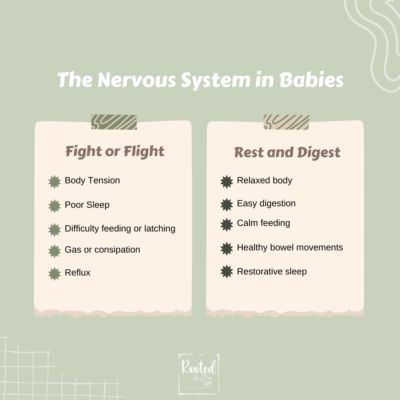
If your baby has colic-like crying, reflux, grunting, and constipation all at once, that’s not a coincidence, and it’s not because your baby has four unrelated problems. It’s often because all of these functions are governed by the same nervous system pathway: the autonomic nervous system, and specifically its “rest and digest” branch, the parasympathetic nervous system, run largely through the vagus nerve.
When that system is functioning well, digestion runs smoothly: the LES holds properly, the gut moves food along at a healthy pace, and the baby can settle into restful sleep. When that system is under stress or interference, all of those functions can falter together, which is exactly why so many fussy babies check multiple boxes on this list rather than just one.
The “Perfect Storm”: How Pregnancy and Birth Set the Stage
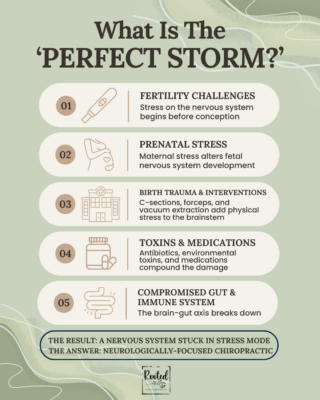
Long before a baby’s first fussy evening at home, a combination of factors can already be shaping how well their nervous system is regulating. This is what we call the “Perfect Storm,” a layering effect of prenatal and birth-related stress that can leave a newborn’s nervous system more reactive than it needs to be.
Contributing factors can include:
- Prenatal maternal stress. Elevated maternal stress hormones during pregnancy can cross the placenta, influencing how the baby’s developing nervous system calibrates to “safe” versus “stressful.”
- Birth interventions. Research has found that the vast majority of newborns (even those from routine, uncomplicated deliveries) show some degree of physical strain in the head, neck, and spine after birth. Interventions like long or induced labors, C-sections, vacuum extraction, and forceps deliveries are sometimes necessary and genuinely lifesaving, but they can also carry physical side effects for a baby that don’t always show up right away, including more pronounced strain on the head, neck, and spine.
- The rapid transition to life outside the womb. Even a straightforward, unmedicated birth is physically intense for a newborn’s still-developing spine and nervous system.
None of this is about placing blame on your pregnancy or delivery, or the choices that were made along the way. Many of these interventions save lives, and we’re grateful they exist when they’re needed. It’s simply about recognizing that birth is physically demanding on a baby’s body, sometimes more than we realize, and that physical stress can carry forward and interfere with how well the nervous system coordinates digestion and sleep in the weeks after.
This is also part of why prenatal chiropractic care matters so much. Techniques like the Webster Technique, which our doctors are certified in, are specifically aimed at supporting balance and alignment in mom’s pelvis during pregnancy, with the goal of helping labor and delivery go as smoothly as possible for both mom and baby. Learn more on our Prenatal Chiropractic page.
Co-Regulation: Why Your Calm Matters (and Why It’s Not Enough on Its Own)
Newborns are not able to self-regulate. Their nervous systems are designed to borrow regulation from a calm, connected adult (usually mom) through a process called co-regulation. It’s why a baby can be perfectly calm in a parent’s arms and start fussing the moment they’re handed off: babies are reading heart rate, breathing pattern, and nervous system state, not just words or tone.
This is genuinely powerful: skin-to-skin contact, a calm voice, slow breathing while holding your baby, and gentle rhythmic movement can all help shift a baby’s nervous system toward “rest and digest.” But co-regulation has a ceiling. If a baby’s own nervous system is dealing with physical interference from birth stress, no amount of parental calm can fully override that on its own. This is often the missing piece for exhausted parents who are doing everything “right” and still not seeing improvement.
How the Nervous System Controls Digestion
It’s worth slowing down on this, because it’s the thread that ties every symptom above together. Digestion isn’t run by the stomach in isolation. It’s run by nerve signals that tell muscles when to contract, when to relax, and glands when to release digestive enzymes and acid.
The vagus nerve is central to this process, connecting the brainstem to the gut, esophagus, and LES. When the vagus nerve and surrounding nervous system are functioning well, digestion is smooth, gut motility is healthy, and the body cycles easily between alert and calm states. When there’s interference, often centered around the upper neck and brainstem, an area especially vulnerable to birth-related strain, that communication gets disrupted, and digestion pays the price.
Why Many Babies Don’t Simply “Grow Out of It”
It’s true that many babies with colic, reflux, or constipation do seem to improve by four to six months. But “improving” and “resolving the underlying cause” are not the same thing. In many cases, the nervous system compensates over time rather than fully recovering, and the underlying dysregulation can resurface later as sleep struggles, sensory sensitivities, feeding pickiness, or behavioral challenges as the child grows.
This is why a wait-and-see approach, while understandable, may leave the root issue unaddressed. Getting ahead of it early (while a baby’s nervous system is still highly adaptable) is often far easier than trying to unwind years of compensation later.
When to Seek Medical Care
Nervous-system-focused care is not a substitute for medical evaluation, and some symptoms warrant a prompt pediatrician or ER visit. Contact your child’s doctor right away if your baby has:
- Poor weight gain or weight loss
- Forceful, projectile vomiting
- Blood in stool or vomit
- Fewer than the expected number of wet diapers for their age
- A fever, especially in a baby under 3 months old
- Signs of dehydration (sunken soft spot, dry mouth, lethargy)
- Persistent green or yellow vomit
- Extreme, sudden inconsolability that seems different from their usual fussiness
For everything else, the day-in, day-out fussiness, grunting, spit-up, and short naps that pediatricians often describe as “normal” but that don’t feel normal to you, it’s reasonable to pursue both reassurance from your pediatrician and a root-cause evaluation of your baby’s nervous system.
How Neurologically-Focused Pediatric Chiropractic Care Evaluates Fussy Babies
It’s important to understand what chiropractic care is, and isn’t, doing here. We are not treating anything as chiropractors. We are making the nervous system function optimally, so the body can do what it’s already supposed to do. The goal isn’t to manage symptoms. It’s to find and remove whatever is interfering with normal function, so the body can take it from there.
At Rooted Family Chiropractic in Holland, MI, that starts long before any hands-on work:
A 1-on-1 parent consultation. We sit down with parents to dig into the full health history, not just “how is the baby doing now,” but the story of how they got here. We start with the basics: is your baby eating well, sleeping well, and pooping well? Those three functions tell us more about nervous system regulation than any single symptom on its own. For newborns, that means a deep dive into the prenatal period and the birth story specifically. Prenatal stress helps “hardwire” a baby’s nervous system for stress, so we talk through things like ultrasounds and complications, job stress, moves, relational stress, and losses in the family during pregnancy. We also cover any major events after birth. The goal of this conversation is simple: figure out why this family is in our office, what’s likely causing it, how it started, and how severe it is.
A hands-on physical exam. From there, we palpate the spine and surrounding musculature, checking tone and how well the spine moves. Alongside that, we do a visual exam, looking for asymmetries in the eyes, ears, and head shape. We explain what we’re feeling in real time, so parents understand what we’re seeing and what we expect to find on the objective scans that follow.
Objective nervous system scanning. Rather than relying on guesswork, we use non-invasive thermal and heart rate variability (HRV) scanning technology to get an objective look at how the autonomic nervous system is regulating, giving both us and the parents real data, not just an opinion.
A personalized care plan, built around what that specific baby’s nervous system needs, not a one-size-fits-all protocol.
Adjustments for infants use an extremely light touch (about the pressure you’d use to check if an avocado is ripe) and are nothing like adjustments for adults. The goal is simply to remove interference so the nervous system can do what it’s already designed to do.

Why Rooted Is Different
There’s no shortage of generic advice for fussy babies: switch formulas, try gripe water, cut out dairy, wait it out. What sets our approach apart is that we’re not covering up a symptom; we’re working to figure out what’s actually causing it, so we can help correct the function underneath it.
We take a nervous-system-first approach, and we’ve built real depth in working specifically with infants. This isn’t a small side focus for us, it’s a core part of what we do every day, with the reps and experience to back it up. And beyond the clinical side, the docs in our office are parents too, so we understand the exhaustion and worry in a very personal way, not just a professional one.
If you’re new to this kind of care, our What to Expect page walks through exactly what a first visit looks like from the moment you walk in.
Serving Fussy Babies in Holland, Zeeland & Hudsonville, MI
Rooted Family Chiropractic is located at 100 S. Waverly Rd, Suite 101, Holland, MI 49423, a short drive for families throughout Holland, Zeeland, Hudsonville, and the surrounding West Michigan lakeshore. If you’ve been searching for a pediatric chiropractor near Holland, MI who specializes in infant colic, reflux, and digestive stress, our office focuses specifically on these cases week in and week out.
What to Expect at Rooted: Brixton’s Story
When Brixton’s mom first came to us, he was six weeks old, and she was exhausted in a way that went beyond typical newborn tiredness. In her words: “I have yet to enjoy my baby, because if he’s awake, all he does is cry.” His longest stretch of sleep was around 45 minutes at a time.
After his very first adjustment, Brixton slept for three hours straight, his longest stretch yet. Over the following weeks of consistent care, he settled into a genuinely happy, easygoing baby, and his mom finally got to experience the newborn stage she’d been hoping for.
Every baby is different, and not every case responds the same way or on the same timeline. But Brixton’s story is a good example of what can happen when the underlying nervous system stress, rather than just the symptoms, is addressed directly. You can read more real stories from Holland-area families on our Stories of Hope page.
Frequently Asked Questions
Why is my baby so fussy all of a sudden? Sudden increases in fussiness can be linked to growth spurts, developmental leaps, or a nervous system reaching a tipping point where it can no longer compensate for underlying stress or tension. Growth spurts also bring an increase in milk volume, and if the digestive system isn’t working efficiently, that added volume can make existing symptoms noticeably worse, even if nothing else has changed. If the change is sudden and severe, rule out illness with your pediatrician first.
Why does my baby only sleep when held? Being held provides warmth, motion, and co-regulation that helps calm an immature or stressed nervous system. Babies who only sleep when held often have nervous systems that haven’t yet learned to self-soothe independently, which can be related to underlying tension or dysregulation.
Why does my baby arch their back while feeding? Arching during or after feeds is a common sign of reflux discomfort, including silent reflux. It can also indicate physical tension in the neck or upper back that makes certain feeding positions uncomfortable.
What does it mean when a baby grunts a lot, especially at night? Occasional grunting is normal as babies learn bowel coordination. Frequent, nightly grunting paired with straining or hard stools may point to constipation linked to nervous system regulation of gut motility.
Is silent reflux different from regular reflux? Yes. Regular reflux (GER) usually involves visible spit-up. Silent reflux (LPR) causes stomach contents to reach the throat without visible spit-up, often showing up instead as hoarseness, coughing, or feeding refusal.
Can colic and reflux happen at the same time? Yes, frequently. Because both are tied to nervous system regulation of digestion, it’s common for a baby to show signs of colic-type crying and reflux symptoms simultaneously.
Does newborn constipation mean something is wrong? A healthy baby should generally have at least one bowel movement a day, similar to the standard for adults, going several days between stools isn’t just a harmless quirk to wait out. Straining, hard pellet-like stools, or clear discomfort during bowel movements are worth evaluating rather than assuming it will simply resolve on its own.
What is “the Perfect Storm” in infant nervous system stress? It refers to the layered effect of prenatal maternal stress, birth interventions, and the physical demands of delivery, which together can leave a newborn’s nervous system more reactive and less able to regulate digestion and sleep.
Will my baby just grow out of colic or reflux? Symptoms may lessen by 4-6 months, but that’s frequently the nervous system compensating rather than the underlying issue resolving. Some children go on to show related sleep, sensory, or behavioral patterns later. Chiropractic care tends to bring relief much faster than simply waiting it out, because it’s working to resolve the root cause of nervous system dysregulation rather than waiting for the body to compensate on its own. It’s also setting your baby up for healthier growth and development going forward, not just calmer days right now.
Is it normal for a newborn to spit up after every feeding? A small amount of occasional spit-up isn’t unusual, but “spit up is just normal baby stuff” isn’t a belief we fully agree with. Frequent, forceful, or distressing spit-up after most feedings is a sign the digestive system isn’t functioning optimally, and it’s worth considering further evaluation rather than just waiting it out.
Isn’t chiropractic just for back pain? Why would a baby need it? Not in this context. We don’t treat specific conditions like reflux or colic directly. Instead, the goal is to optimize nervous system function so the body can do what it’s already designed to do: for a baby, that means eating, sleeping, and pooping with ease. If there’s stress or tension in the neurospinal system, it can interfere with those natural processes and keep a baby’s body stuck in a fight-or-flight state, which gets in the way of digestion and rest. Our job is to help remove that interference between brain and body so the nervous system can find balance and function the way it’s meant to, not to treat a specific symptom.
How does chiropractic care help with colic or reflux? Gentle, infant-specific adjustments aim to relieve physical tension around the neck and rest of the spine that can interfere with nervous system communication to the digestive tract, supporting the body’s own ability to regulate digestion.
Is chiropractic care safe for newborns? Yes. Pediatric adjustments use extremely light, precise pressure appropriate for a newborn’s developing spine, nothing like adjustments used for adults.
How soon will I see results? This varies by baby. Some parents notice changes within the first one to two visits, as with Brixton; others see gradual improvement over several weeks of consistent care.
When should I call the pediatrician instead of pursuing other care? Always contact your pediatrician for poor weight gain, projectile vomiting, blood in stool or vomit, fever in a baby under 3 months, signs of dehydration.
Can maternal stress during pregnancy really affect my baby’s digestion after birth? Research suggests that elevated maternal stress hormones during pregnancy can influence a baby’s developing nervous system, which in turn helps regulate digestion, sleep, and stress response after birth.
Is there a pediatric chiropractor near Holland, MI who helps with infant colic and reflux? Yes. Rooted Family Chiropractic, located at 100 S. Waverly Rd, Suite 101 in Holland, MI, focuses specifically on neurologically-focused care for infants and families throughout Holland, Zeeland, and Hudsonville, including colic, reflux, silent reflux, and constipation.
The Bottom Line
If you’re exhausted, googling symptoms at midnight, and being told your fussy, grunting, refluxy baby is “just colicky” or will “grow out of it,” trust what you’re seeing. Persistent fussiness, reflux, and constipation are often connected by one root cause: a nervous system that needs support to regulate digestion the way it’s designed to.
If the usual advice (formula changes, positioning tricks, waiting it out) hasn’t moved the needle, that’s exactly when a root-cause, nervous-system approach tends to make the biggest difference. You don’t have to keep guessing your way through sleepless nights.
Ready to find out what’s really going on with your baby? Schedule an evaluation with Rooted Family Chiropractic to get a clear picture of your baby’s nervous system function and a personalized plan to help your family finally get some rest.
Rooted Family Chiropractic proudly serves families throughout Holland, Zeeland, and Hudsonville, MI. 📍 100 S. Waverly Rd, Suite 101, Holland, MI 49423 📞 616-886-5883
