

I have two beautiful girls who were born at home and although I haven’t completely closed the book on having more, I do think I’m done having babies. With that being said, I spend most of my days with pregnant and postpartum moms, and if there’s one conversation I have on repeat, it’s this one: who do I actually need on my team?
So I decided to answer it the way I wish someone had answered it for me, not as a checklist, but as a walk through my own two births, and the people who made all the difference in each one.
The Most Important Person on Your Team Isn’t a Provider
Before I get into midwives and doulas and chiropractors, I have to start here, because it’s the piece I talk about the most and the one people are least prepared for.
If you want an unmedicated birth, there will be a moment — maybe more than one — where you are absolutely convinced you cannot do this anymore. That moment is not a sign that something is wrong. It’s usually a sign that you’re close.
In my first birth, about 14 hours in, I told everyone I was done. I wanted to transfer, I wanted the epidural, I was finished. My husband, Dr. Rob, turned to my midwife and asked if there was any medical reason we needed to transfer. She said no. And he looked at me and said, “We aren’t transferring. Push.” I was so close and my daughter would be born in about an hour. I just couldn’t see it from inside the pain.
It happened again in my second birth, this time only an hour and a half in, which felt insane given that my first labor had been 15 hours. I said, “I don’t want to do this.” And Rob, so gently, said, “You really don’t have a choice.” My birth photographer, standing quietly nearby, added, “Kass, that means you’re almost done.” I still think about that sentence.
Neither of those moments would have gone the way they did if Rob and I hadn’t already talked about it. We’d had the conversation ahead of time, before labor, before the pain, about what I wanted, how far I wanted to be pushed, and what “no medical reason to transfer” would mean if I hit a wall. He wasn’t guessing in the moment. He was executing a plan we’d made together.
If you take one thing from this post: have that conversation with your partner now, while you’re clear-headed. Decide together what support looks like when you’re not clear-headed anymore.

Midwives/OBGYNS
I had three midwives present for my first birth, and every one of them was steady, attentive, and exactly what I needed, including in that moment when Rob asked if we had a medical reason to transfer and she calmly said no. That’s the thing about a good midwife team: they’re not just there to catch the baby. They’re tracking you and the baby closely enough that they can give your partner an honest, low-drama answer in the middle of your hardest moment, which then lets him support you with confidence instead of fear.
But before you ever get to that moment, you have to choose the provider in the first place, and this is where I think a lot of moms skip a step. Whether you end up with a midwife or an OB, the provider you choose is one of the single biggest factors in how your birth actually goes. Not because any one provider is “bad,” but because every provider has a philosophy, and that philosophy will shape your options in the room whether you know it going in or not.
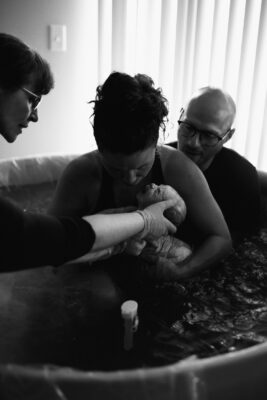
So before you sign on with anyone, I’d sit down with them, ideally at your very first appointment, before you’re attached, and ask some version of these questions:
- What is your overall philosophy on labor, delivery, and interventions? This is the big one. Let them talk. You’re listening for whether their default approach matches the kind of birth you’re picturing for yourself.
- How do you feel about unmedicated birth, and what natural pain relief options do you support? You want a provider who is genuinely comfortable with this, not just tolerant of it.
- What are your rates on routine inductions, C-sections, and episiotomies? Ask for actual numbers, not vibes. A provider confident in their outcomes will have them and share them freely.
- Will you support my birth plan if my labor is progressing normally? This tells you whether your plan will actually be honored when things are going fine, or whether it gets overridden by routine protocol regardless.
- What are your transfer rates, and how do you handle emergencies? (This one’s especially important for midwives and home birth or birth-center settings.) You want to know exactly what the plan is before you’re in an emergency, not during one.
- What’s your philosophy on routine testing, like ultrasounds, glucose screening, and GBS, during pregnancy?Every provider has a default here, and it’s worth knowing whether “routine” for them means “required” or “offered.”
Here’s the important part: the goal of asking these isn’t to get the answers I got, or the answers I’d give you. It’s your birth, and your answers might look completely different from mine. What matters is that your provider’s answers actually match what you want, not that you find out too late, in the middle of labor, that they don’t.
Although your birth is yours, I strongly encourage you to do a little of your own research on common birth interventions before you go into these conversations. Something being routine doesn’t automatically mean it’s necessary for you. Ask the questions, get informed, and then choose the provider, and the plan, that’s genuinely yours.
West Michigan has amazing birth providers and I am lucky to have some great recommendations. Brenda Ruth and West Michigan Midwifery are at the top of my list. I have also heard great things from practice members about Holland Midwives.
Doulas and Birth Photographers
I talk to a lot of moms who assume a doula is only for people without a supportive partner. That’s not it at all. A doula isn’t there instead of your husband, she’s there to support both of you, so he can be fully present with you instead of managing logistics, timing contractions, or wondering what to do next.
She’s also there as an advocate to the rest of your care team, helping make sure you’re getting the birth you actually desired, as long as it’s safe. That role matters more than people realize. In the middle of labor, you and your husband may be overwhelmed, exhausted, and emotional, and it’s genuinely hard to make clear-headed decisions in that state. Having someone in the room whose only job is to keep your wishes in view, and gently speak up for them when you can’t, takes a weight off both of you.
And don’t underestimate the quiet power of someone like a birth photographer in that room. A lot of people don’t realize many birth photographers also have doula training, so they bring both roles at once: steady support and a way to hold onto the moment forever. Mine wasn’t there to coach me, but one sentence from her, at exactly the right second, gave me the encouragement I needed to keep going. I had a photographer at both of my births, and those photos are something I will treasure forever. The people in your birth space don’t all need a single clinical role to matter. Sometimes the right words, or the right photograph, from the right person at the right moment change everything.
My top doula recommendations are Baby Bird Birth Services, Golden Hours Doulas, and Alyssa Zapata but there are many incredible doulas in the area.

Pelvic Floor Therapy
By my second pregnancy, I added pelvic floor therapy to my team, and it completely changed how I understood what this work actually is. Most people hear “pelvic floor therapy” and think Kegels and strengthening, full stop. But not everyone needs strength. Sometimes what your body actually needs is the opposite: stretching, lengthening those muscles, or simply learning how to relax and control them rather than clench them tighter. For me, it was that release work that made the real difference.
A great pelvic floor therapist doesn’t stop at the muscles either. Mine helped me with labor positions, breathing, and learning how to push effectively, all things that mattered just as much on the actual day as anything we worked on in the months leading up to it. I have to give a shout-out here to Mamas and Misses Pelvic Floor PT, who was a huge part of my second birth going the way it did.
I had a session the very morning my second daughter was born. My PT wished me well as I left my appointment and I texted her early that evening that my daughter was born at 4 PM. I don’t think that’s a coincidence. If you’re pregnant and someone tells you pelvic floor PT is only for postpartum recovery, I’d push back on that gently, it can be just as valuable going into birth, and it’s about so much more than strengthening.
Lactation Support
This is the one I really want every pregnant mom to hear, because I learned it the hard way and then did it differently the second time, and honestly, I’ve kept learning about breastfeeding ever since having my first baby.
Something I wish more moms knew going in: lactation support isn’t just for when something goes wrong after baby arrives. It can happen before birth too, to help you actually prepare for breastfeeding, not just troubleshoot it once you’re already in the thick of it. Having a trusted lactation specialist in your corner matters for something even more basic than fixing problems, it’s about understanding what’s normal and what isn’t. How much milk you should actually have, and when it’s supposed to come in. If there’s ever concern about intake, weighted feeds are an option to get real numbers instead of just guessing. That’s the kind of information that’s so much easier to have on hand ahead of time than to be scrambling to find at 2 a.m. with a screaming newborn.
After my first daughter, I didn’t see a lactation consultant proactively, I figured we’d deal with it if something came up, and something did (that painful first week I mentioned above, which chiropractic ultimately resolved). With my second daughter, I met with a lactation specialist soon after she arrived, before anything major even came up, just to get ahead of it. It was so helpful. We caught small things early and it helped my confidence that my baby and I were doing just fine together.
For my second baby, I worked with Anne at Foundational Feeding, and that early support made all the difference. I also have so many practice members who’ve had an amazing experience with Kelsey at Supply Sis, she’s someone whose expertise I respect and trust enough that she’s a guest speaker at our Birth and Beyond workshop.
You don’t have to wait for a painful week to justify seeing a lactation consultant. Meeting with one proactively, even if everything seems fine, is one of the most underrated pieces of preparation I can recommend.
Prenatal Chiropractic Care
Chiropractic is a piece that so often gets missed when women are building their birth team, especially nervous system focused care, which is what we provide at Rooted. I had chiropractic care and massage through both pregnancies, but my second pregnancy, with that nervous system focus, is where I really understood what it could do.
There are really two pieces to it. The first is pelvic balance. A balanced pelvis helps with mom’s comfort throughout pregnancy (I have to give a shout-out to my own chiropractors here, because I had very little discomfort in either of my pregnancies, and I don’t think that’s a coincidence). Beyond comfort, a balanced pelvis also gives baby plenty of room to get into an ideal position for birth, and it’s simply the best possible passageway for baby to exit the world.
The second piece is the nervous system, and this is the part I wish more moms understood. Your nervous system controls everything — including your hormonal system, which is what starts labor, progresses labor, and then helps stop blood loss and support the breastfeeding journey postpartum. A nervous system that’s stressed out can’t do these things as well, and that shows up as interference with the normal, physiological functions of pregnancy, birth, and postpartum. The goal of this kind of care is to help the body adapt to stress so it can function the way God designed it to in the beautiful process of birth.
Here’s the story I share most often, though: after my first daughter’s birth, which was long and hard, breastfeeding was excruciating for the first several days. I didn’t know what was wrong. What ended up making the biggest difference wasn’t a lactation consultation, it was chiropractic care. Her birth had been physically intense, and that tension was showing up in ways that were affecting how she could feed. Once we addressed it through chiropractic, things turned around.
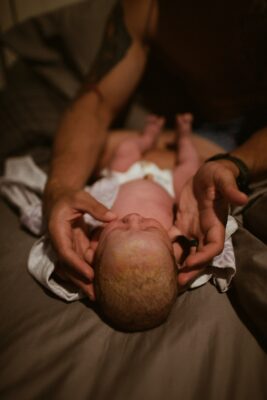
That experience is exactly why prenatal (and infant) chiropractic care made my list. It’s not just a “nice to have” for back pain in pregnancy, it can directly affect labor, birth, and even how smoothly breastfeeding starts.
If you’re pregnant and you haven’t had your nervous system checked yet, I’d love to be part of your team. Come in for a nervous system consultation and exam with me, and let’s see what your body needs to adapt to the beautiful, demanding work of pregnancy, birth, and postpartum ahead of you.
Building Your Own Team
I’m not planning on having another baby, but if I were starting from scratch with my first, this is the team I’d want in place before I ever went into labor: midwives I trusted to be honest with my partner in the hardest moments, a doula and support people who could hold space alongside him rather than instead of him, a chiropractor tracking my nervous system through pregnancy, a pelvic floor therapist helping my body release rather than just strengthen, and a lactation consultant lined up early, ready to go the moment baby arrived, before any problems had a chance to take hold.
But more than any single provider, the biggest lesson from both of my births is the conversation I had with Rob before either of them started. The team around you matters. The plan you make with your partner, before the pain arrives, might matter even more.
So here’s the question I’d leave you with: if you hit that moment, the one where you’re sure you can’t do this anymore, who is in the room, and do they already know what you need them to say?
Want my full list of recommendations for each of these categories of birth workers? Email me at contact@therootedfamilychiro.com and I’ll send them to you!
